Takaki216
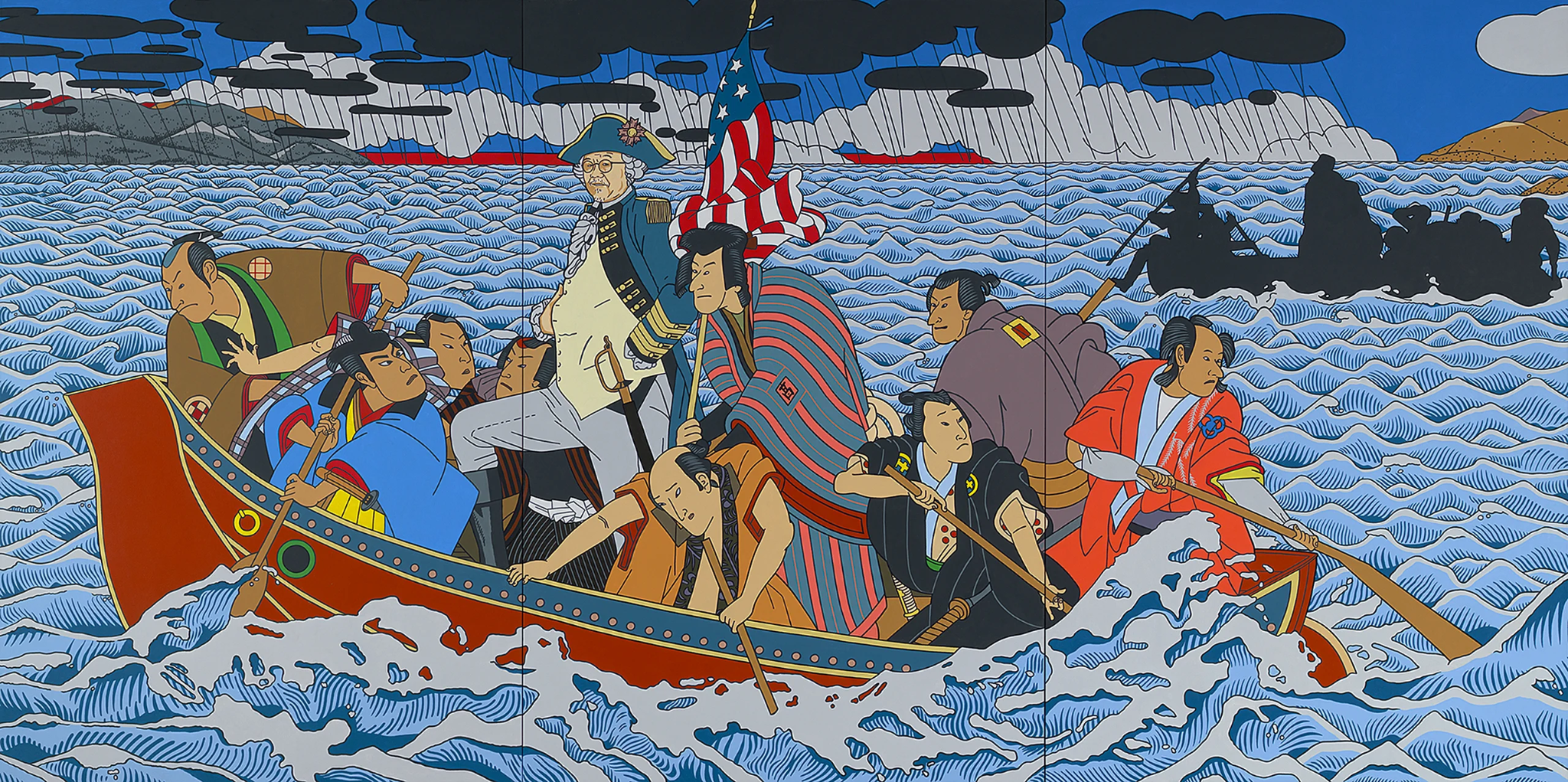
Detail of Roger Shimomura’s Shimomura Crossing the Delaware.
Roger Shimomura, Shimomura Crossing the Delaware

Key idea 02 · Across the whole book

Race is socially constructed

How do people turn differences into boundaries—and how can those boundaries change?

Gist

People made the rules about race. Those rules decide who gets treated as belonging and who gets treated unfairly. People can change the rules.

Check your understanding
Check your understanding: What does “people made the rules about race” mean?

Academic definition

Racial categories and hierarchies are created and enforced through social beliefs, laws, and institutions. Their meanings change across time and place, while their effects on rights and opportunities are real.

Check your understanding
Check your understanding: Which detail shows a racial category being enforced by an institution?

Elaboration

Race is socially constructed means people and institutions decide which differences count, attach meanings to them, and organize rights around those meanings. In Takaki’s taxi encounter, appearance becomes a test of Americanness; in colonial Virginia, courts and lawmakers gave Black and white laborers different legal futures.

Those decisions produce real effects. Freedom from slavery did not stop northern employers, schools, and voting rules from limiting Black lives. Later, Chicago housing organizations pressured owners to exclude Black residents. These examples show how a racial boundary can be maintained through everyday decisions as well as a formal law.

Because people build these boundaries, people can challenge them. Citizenship reforms and school desegregation changed legal rules, while resistance delayed equal treatment. The epilogue’s victories therefore mark struggles over institutions, not the disappearance of racism. Ask both who creates a category and what power makes it matter.

YPT 5–6 YPT 51–52 YPT 86–88 YPT 260 YPT 299 YPT 302–304 YPT 340
Check your understanding
Check your understanding: What does the John Punch example show?

How a boundary gains power

  1. 01

    Classify people

    People assign group meanings to ancestry, appearance, language, or customs.

  2. 02

    Set the rules

    Officials, employers, and other institutions use those classifications to decide who qualifies.

  3. 03

    Distribute opportunities

    Rules shape access to land, work, education, citizenship, and safety.

  4. 04

    Defend or challenge

    People justify unequal outcomes or organize to change the rules and how they are enforced.

Compare across chapters

Follow the connections

01

Who gets to define civilization?

English colonizers and later US officials treated their own customs as standards for judging Native peoples. Yet adopting approved practices did not reliably protect Native land or governing authority. Comparing these chapters reveals changing demands backed by a continuing imbalance of power.

Chapter 2

English settlers claimed that Native people did not deserve land because they failed to work it. The chapter supplies evidence of Native farming, exposing the gap between the justification for taking land and the practices actually present.

YPT 35–36
Chapter 4

Some Choctaw adopted enclosed farms and commercial cotton growing. Mississippi still ended the Choctaw Nation’s legal authority in 1830. Practices praised among white planters did not protect Choctaw farmers from dispossession.

YPT 71
Chapter 9

The Dawes Act connected individual land allotments with citizenship, while later last-arrow ceremonies presented abandoning Native names and customs as progress toward American membership. Officials made their preferred way of life a test of belonging.

YPT 174 YPT 184–186

The policies differed: removal pushed Native communities away, while allotment sought to reorganize them. Both empowered outsiders to judge Native life and weaken collective control. Ask who sets the standard and whether meeting it changes the unequal relationship, rather than assuming assimilation guarantees equality.

02

Citizenship rules shape work and property

A racial rule about citizenship can reach far beyond a passport or ballot. When employment or property rules depend on eligibility for citizenship, one exclusion creates another. Irish, Chinese, and Japanese experiences show that immigrant hardship did not give every group the same legal position.

Chapter 6

Irish immigrants faced hostility as Catholics and foreigners, yet their classification as white gave them access to naturalization. Irish Americans used voting and political organizations to gain influence and public jobs, advantages unavailable on the same terms to other groups.

YPT 112 YPT 119
Chapter 8

California’s 1852 mining tax targeted foreign miners who did not intend to become citizens. Chinese miners were barred from naturalization, so officials taxed a status that the miners could not simply choose to leave.

YPT 148
Chapter 10

Hawaiian planters tied skilled jobs to citizenship eligibility, and California’s Alien Land Law tied land purchases to the same boundary. Japanese immigrants’ experience or farming ability could not remove a legal obstacle based on racial classification.

YPT 193 YPT 208

Follow the chain from classification to eligibility to opportunity. These examples do not show that every white immigrant prospered or that every Asian immigrant had the same experience. They show how linked rules gave racial categories practical force across several parts of life.

03

Institutions make unequal opportunity

Employers and schools did more than reflect private prejudice: they made decisions that sorted people into unequal futures. The chapters on Mexican labor and Jewish education show different ways institutions could turn ancestry into a supposed measure of ability, even when achievement challenged the stereotype.

Chapter 7

Mexican workers received lower wages even when doing the same work as Anglos. A mine owner defended the arrangement as their natural condition, treating a hierarchy maintained by employers as though it came from the workers themselves.

YPT 139
Chapter 11

Harvard responded to Jewish students’ growing presence with new admissions guidelines and required photographs. Officials treated Jewish identity as something they could detect from facial features, turning an imposed group boundary into an educational obstacle.

YPT 230–231
Chapter 12

Some educators and growers expected Mexican American children to remain manual laborers and discouraged further schooling. The chapter also describes teachers who respected students’ language and identity, showing that education could reinforce or challenge those expectations.

YPT 246–247

Notice the difference between limiting education to preserve a labor force and restricting admission despite strong academic performance. Both make group identity consequential, but through different decisions. Explain the institution’s action before judging its outcome; unequal results alone do not tell you how exclusion happened.

04

Belonging changes with political choices

War, organizing, and public fear changed how communities were treated without changing their ancestry. These changes reveal that national belonging was neither fixed nor secured by contribution alone. Compare official rules with everyday recognition: gaining one kind of acceptance did not automatically bring the other.

Chapter 14

West Coast authorities confined people of Japanese ancestry, including citizens, while Hawaii’s military governor resisted mass confinement. During the same war, Chinese Americans described greater acceptance, and Congress repealed Chinese exclusion while retaining a tiny immigration quota.

YPT 275–276 YPT 282–283
Chapter 15

Japanese American legal challenges and lobbying helped change property and citizenship rules. Mexican American and Black challenges to school segregation also changed law, but delayed integration showed that a legal victory still required further action to become everyday practice.

YPT 298–299 YPT 302–304
Chapter 16

After 9/11, some Afghans hid their background to avoid abuse, while Fatema Nourzaie described belonging to both Afghan and American communities. Her account challenges the assumption that keeping Afghan culture conflicts with American belonging.

YPT 327–328

Different wartime decisions and later reforms show that authorities had choices; ancestry did not dictate one inevitable policy. Nourzaie’s experience then exposes a remaining problem: American identity and cultural belonging can still be questioned in public life after explicit racial restrictions in law have changed.

Find it in every chapter

17 chapter connections

Open a chapter for its explanation, supporting evidence, and original page links.

01Why a Different Mirror?

The chapter shows racial categories doing social and legal work: appearance becomes a supposed test of national belonging, and classification as white affects eligibility for citizenship. These examples connect unequal treatment to people’s assumptions and institutional rules rather than to any inherent difference in who can be American.

  • Takaki’s driver treats him as foreign despite his US birth; Takaki connects this assumption to a historical narrative equating Americans with whiteness.

    YPT 5–7
  • The introductory comparison explains that Irish immigrants’ classification as white made them eligible for citizenship under the rule it describes.

    YPT 12

What changes when we ask who set the rule for belonging, instead of accepting that rule as natural?

Open Chapter 1 study guide ↗
02Removing the “Savages”

The English created a hierarchy by deciding whose religion, customs, and ways of using land counted as civilized. They first applied the label “savage” to the Irish, then carried that judgment to Native peoples. The category served English rule; it did not objectively describe either people.

  • English rules separated Irish people from colonizers through restrictions on property, officeholding, dress, and marriage.

    YPT 27–28
  • English observers compared Native peoples to the Irish. Claims that Native people did not work the land ignored the farms the English encountered.

    YPT 30 YPT 35–36

Who had the power to define “civilized,” and what did that definition let them do?

Open Chapter 2 study guide ↗
03The Hidden Origins of Slavery

Virginia’s racial hierarchy took shape through unequal punishments, property claims, and laws. The chapter begins with Black and white laborers sharing coercion and sometimes cooperating, then follows authorities making racial status increasingly consequential. Those decisions created different legal futures; the differences were not a natural feature of plantation work.

  • After three servants ran away together in 1640, the two white men received added terms while John Punch received lifetime servitude.

    YPT 51
  • Later laws restricted Black people’s access to weapons and enslaved people’s movement and association.

    YPT 59

Which legal decision best shows racial difference being turned into unequal power?

Open Chapter 3 study guide ↗
04The Road to the Reservation

Native people’s treatment did not depend simply on whether they farmed or adopted practices whites praised. Governments continued to assign them a subordinate position and undermine their collective authority. The contrast between farming practices and unequal legal treatment reveals a racial boundary maintained through policy and power.

  • Choctaw people practiced agriculture and some grew cotton, yet farming did not bring them the treatment or security given to white planters.

    YPT 71
  • State governments worked to end Native governing authority and place individuals under white-controlled state law.

    YPT 69–71

How does the treatment of Choctaw farmers challenge the claim that farming alone determined who deserved land?

Open Chapter 4 study guide ↗
05Life in Slavery

The chapter shows racial inferiority being taught and enforced through institutions rather than demonstrated as a fact. Laws, segregated spaces, job restrictions, and slaveholders’ stereotypes assigned unequal positions to Black people. Different legal statuses in North and South also show that a racial hierarchy could operate through more than one system.

  • Northern rules and practices restricted Black schooling, housing, work, and voting despite legal freedom.

    YPT 86–88
  • Southern slaveholders used contradictory images of helpless contentment and threatening violence to interpret and control enslaved people.

    YPT 89–91

What do contradictory stereotypes reveal about the purpose of racial ideas?

Open Chapter 5 study guide ↗
06The Flight from Ireland

Irish immigrants could be treated as outsiders because of religion and origin while also receiving advantages as legally white people. Some sought acceptance by distancing themselves from African Americans. The chapter therefore shows racial position being made through laws, political alliances, and exclusion, rather than simply reflecting immigrant hardship.

  • The chapter describes Irish newcomers using anti-Black hostility to identify with a white American in-group despite anti-Irish prejudice.

    YPT 112–113
  • White classification gave Irish immigrants access to naturalization and helped their political rise; Chinese immigrants and many Black Americans faced different legal barriers.

    YPT 119

How could anti-Irish prejudice coexist with advantages denied to other groups?

Open Chapter 6 study guide ↗
07The War Against Mexico

A new border made Mexican residents part of the United States, but citizenship did not secure equal social standing. Officials and employers treated Spanish language and Mexican ancestry as markers of foreignness or low status. Voting practices, taxes, and workplace hierarchies gave those classifications concrete consequences.

  • California's foreign miners' tax was collected mainly from Spanish-speaking miners, including US citizens of Mexican ancestry.

    YPT 134
  • Job rank and wages were tied to race: Anglos commonly held supervisory or machine jobs while Mexican workers received harder work and lower pay.

    YPT 139

What made some citizens remain treated as foreigners in their own homes?

Open Chapter 7 study guide ↗
08From China to Gold Mountain

Laws made racial classification determine access to citizenship, courtroom testimony, marriage, and entry. The foreign miners' tax then penalized Chinese miners for a citizenship choice they were legally denied. These rules actively produced a class of permanent foreigners instead of merely describing where people had been born.

  • The 1852 mining tax targeted people not intending to naturalize even though Chinese miners were barred from naturalization.

    YPT 148
  • California grouped Chinese people with other nonwhite populations when restricting testimony against whites and marriage across racial categories.

    YPT 153

How did different laws reinforce one another to make Chinese people seem permanently foreign?

Open Chapter 8 study guide ↗
09Dealing with the Indians

Officials and writers defined a hierarchy between Native life and the life they called civilized. They then made landholding, schooling, work, names, and customs into tests of fitness for American membership. Those standards gave political force to racial classifications by treating Native culture as something government should replace or manage.

  • Walker expected reservation training to turn Native people into settled workers; Dawes treated communal landholding as an obstacle to civilization.

    YPT 173–174
  • Last-arrow pageants symbolically directed Native participants to abandon an Indian way of life for a white one and tied the ceremony to citizenship.

    YPT 184–186

What social and cultural choices did officials turn into supposed measures of racial progress?

Open Chapter 9 study guide ↗
10The Japanese and “Money Trees”

Institutions turned racial labels into unequal opportunities. Planters connected skilled jobs to citizenship eligibility, while California connected land purchases to the same boundary. These rules made a social classification materially powerful; Japanese workers’ farming knowledge or years of residence did not determine their legal standing.

  • A 1904 planters’ resolution made citizenship eligibility a condition for skilled positions, excluding Asian workers in the chapter’s account.

    YPT 193
  • The Alien Land Law and the Supreme Court’s rejection of Takao Ozawa’s citizenship application made racial classification a barrier to property and naturalization.

    YPT 208

What makes these racial boundaries products of decisions and rules rather than measures of ability?

Open Chapter 10 study guide ↗
11Jews Are Pushed from Russia

The chapter shows people treating Jewish identity as a supposedly visible, fixed group boundary. Harvard required photographs because officials believed facial features could reveal Jewish applicants even after name changes. Such institutional choices turned an imposed classification into a barrier, showing how social judgments could restrict opportunity.

  • Harvard’s admissions process required photographs in a climate where people claimed Jewish identity could be read from facial features.

    YPT 231
  • Property rules sometimes barred sales to Jews as families sought homes outside the Lower East Side.

    YPT 233–234

What decisions made Jewish identity a boundary to educational or housing access?

Open Chapter 11 study guide ↗
12Up from Mexico

Schools, workplaces, and courts made racial judgments consequential. Mexican American pupils were directed toward manual labor through claims of inferiority, while courts’ classification of Sikh men blocked naturalization and landownership. These were imposed boundaries, not evidence of ability, and families sometimes found ways to navigate them.

  • Some segregated schools discouraged Mexican American students from high school because educators and growers expected them to remain manual laborers.

    YPT 246–247
  • Sikh men were excluded from naturalization and land purchases; some families acquired land through Mexican wives.

    YPT 245

Which institutions converted racial labels into limits on a person’s future?

Open Chapter 12 study guide ↗
13Blacks Arrive in Northern Cities

Racial boundaries were maintained through actions: neighborhood groups pressured property owners, employers divided workers, and landlords’ discrimination restricted movement. These practices gave racial labels practical consequences in northern cities. The existence of later efforts at interracial organizing also shows that separation had to be maintained and could be challenged.

  • Chicago housing organizations tried to stop sales and rentals to Black residents; employers sponsored a separate union to block cooperation.

    YPT 260–262
  • During the 1930s industrial unions sought Black members and pledged opposition to discrimination, though racism persisted.

    YPT 268

Which rules or organized choices would have to change for a racial boundary to lose power?

Open Chapter 13 study guide ↗
14World War II and America’s Ethnic Problem

Officials treated ancestry as a guide to loyalty, but their decisions varied by place and group. The treatment of Japanese Americans and changing acceptance of Chinese Americans show that racial boundaries depended on political judgments and wartime alliances. Neither ancestry nor citizenship alone determined how people were treated.

  • West Coast officials treated Japanese ancestry as grounds for removal, including for citizens; Emmons resisted mass confinement in Hawaii.

    YPT 275–276
  • Chinese American accounts describe new acceptance during the war, and Congress repealed exclusion while retaining a tiny immigration quota.

    YPT 282–283

What changed in wartime society’s treatment of these groups even though people’s ancestry had not changed?

Open Chapter 14 study guide ↗
15Calls for Change

Courts and legislatures had made racial categories determine access to property, citizenship, and education. Activists challenged those arrangements, and the rules changed. This shows racial inequality being organized and contested through institutions, rather than arising naturally from differences among people. Changing a rule still did not immediately change social practice.

  • The Oyama case challenged land restrictions tied to the family’s inability to naturalize; in 1952 Congress removed remaining racial barriers to seeking citizenship.

    YPT 298–299
  • Mendez and Brown challenged racial school separation, but the chapter emphasizes the delay between a ruling and integration in practice.

    YPT 302–304

Which institutions gave racial categories power, and what happened when activists challenged their rules?

Open Chapter 15 study guide ↗
16New Waves of Newcomers

Rules and public perceptions shaped who could enter and who was treated as belonging. The chapter argues that national-origin quotas also operated as racial exclusions. After 9/11, Afghan Americans faced suspicion, and some people were targeted because of perceived appearance, showing how outsiders imposed broad categories on distinct communities.

  • The chapter explicitly connects national-origin quotas for several Asian and African countries to racial discrimination.

    YPT 318
  • Nourzaie recalled hostility after 9/11 toward Muslim women and people perceived as Middle Eastern, while some Afghans concealed their background to avoid abuse.

    YPT 327

What happens when people are grouped by someone else’s assumptions about ancestry, appearance, or religion?

Open Chapter 16 study guide ↗
17“We Will All Be Minorities”

The epilogue shows racial boundaries operating through institutions: slavery, unequal treatment after military service, and restrictions on citizenship and marriage. It then lists reforms that changed those boundaries. This contrast supports an interpretation of racial inequality as historically produced and contested, rather than a fixed consequence of human difference.

  • Military contributions did not prevent Japanese American families’ confinement or the denial of rights to African American veterans.

    YPT 338
  • The author lists access to naturalized citizenship regardless of race and the overturning of interracial-marriage bans among victories.

    YPT 340

What do changing citizenship and marriage rules reveal about the power that society gives racial categories?

Open Chapter 17 study guide ↗

Build your own connection

Compare two chapters in which an institution turned group identity into a boundary: how was each boundary enforced, and what evidence shows it could change?

Build a comparison using your own evidence. Each bracket names the kind of information to supply.

In chapters [number] and [number], [institution or practice] and [other institution or practice] gave the category [racial label] power through [rules or actions]. The important difference was [specific difference], which helps explain [different outcome].

One possible model

In Chapter 6, access to naturalization and political power helped Irish immigrants gain conditional acceptance as white, but in Chapter 8, laws denied Chinese residents citizenship and other rights. The contrast shows institutions giving racial categories different consequences.

YPT 119 YPT 148 YPT 153

Why it works: The model compares two institutions and explains how their rules made racial categories matter in people’s lives.