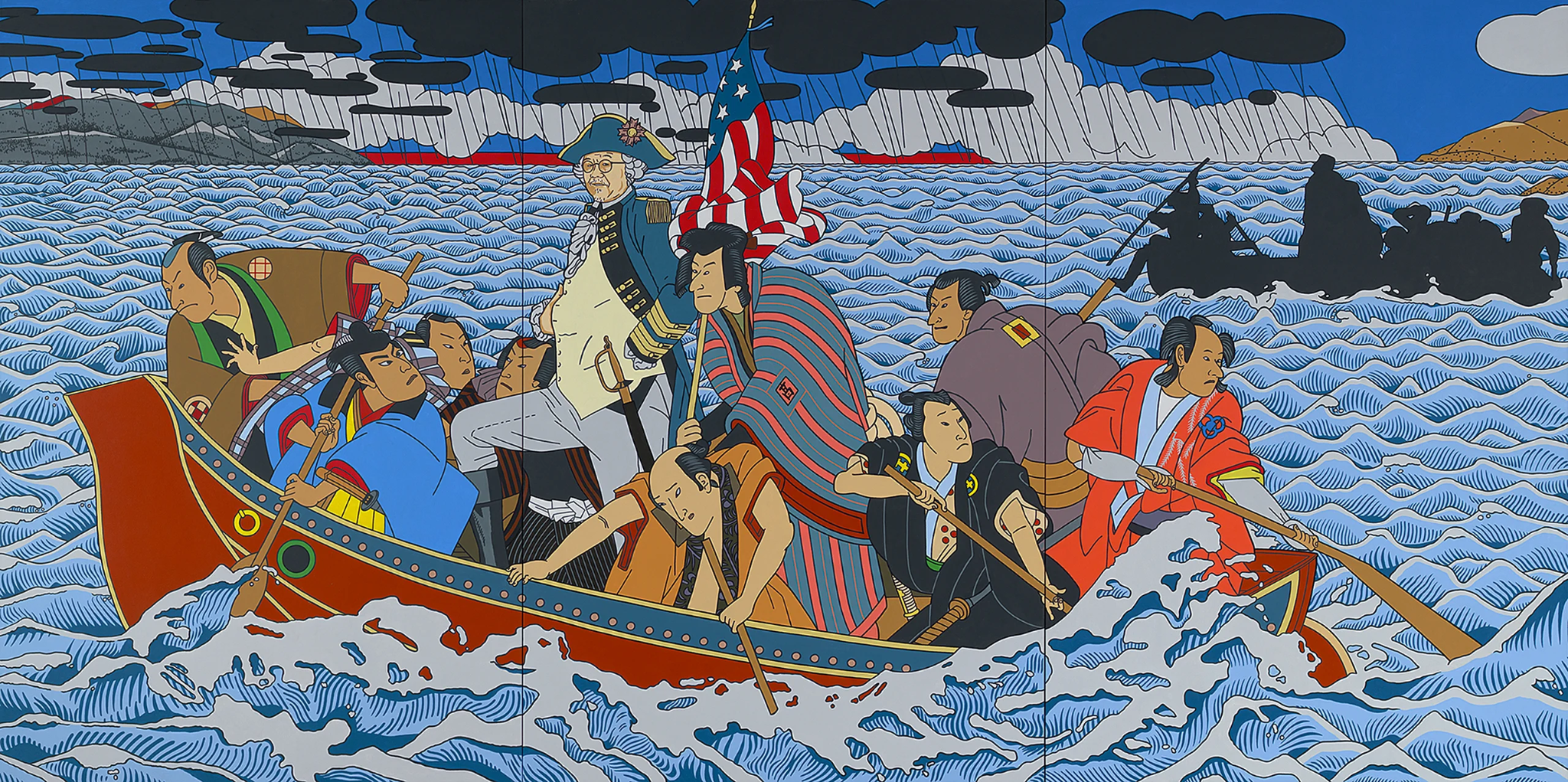
How were slavery, China, and Manifest Destiny major factors governing America's decision to go to war against Mexico?
Course aim
All chapter content is shown below. Expand models and evidence when you want the complete reference view.
READ WITH A PURPOSE
How did conquest turn many Mexican landowners into workers, and how did Mexican communities challenge the new order?
Connect Texas cotton and slavery to settler conflict, California's Pacific harbors to China trade, and civilizing rhetoric to expansion. Distinguish underlying ambitions from the border clash used to justify war.
Compare the two sides and their overlap. Select one to emphasize it.
Community mutualistas and the Japanese Mexican Labor Association · YPT 139–142
What this comparison shows
Both circles show people becoming stronger by organizing together, but they organize in different ways. On the left, mutualistas were Mexican American community groups that pooled contributions to help with loans, hospital bills, and funerals. On the right, the Japanese Mexican Labor Association united farmworkers in Oxnard to strike against wage cuts. The overlap is solidarity: cooperation around a shared need or struggle. Community ties could supply everyday support, while an alliance across ethnic groups could unite workers facing the same employer. Mexican union members showed this commitment by refusing membership in a larger labor organization that excluded their Japanese partners. The diagram helps us see that solidarity can grow within a cultural community and across communities. The useful question is how people support one another, not whether everyone shares an ancestry.
Mutualistas were broader community organizations; the JMLA was a particular labor union. Their shared purpose does not make their membership, structure, or outcomes identical.
Think it throughWhat could workers gain from organizing through both ethnic communities and alliances across ethnic boundaries?+
Community organizations could provide material help and cultural belonging. An alliance like the JMLA could unite workers facing the same wage cuts across ethnic boundaries. The Mexican members' refusal to abandon Japanese coworkers made equal treatment a condition of solidarity, even though the union later disappeared (YPT 140–142).
02 / Connect
Connect conquest to everyday power
Follow the whole sequence. Open evidence beside a step.
Keeping a land title could become too expensive.
After conquest, the United States removed the treaty provision guaranteeing existing property titles and directed Mexican landowners to American courts for confirmation. YPT 132–133 ↗YPT 135 ↗
01New rules for ownershipLandowners must defend claims in American courts.
Evidence for this step
Step 1 / New rules for ownership
Claims could fail under unfamiliar legal and surveying standards. Squatters also occupied Mexican-owned land and refused to leave.
03Land passes to othersOwners sell land to meet debts and losses.
Evidence for this step
Step 3 / Land passes to others
Some owners who won their claims still sold land to repay what they owed. Unequal access to credit during drought also helped Anglos acquire land from struggling Mexican owners.
04Former owners seek wagesMany Mexicans become laborers.
Evidence for this step
Step 4 / Former owners seek wages
The chapter describes Mexicans working as day laborers on land once theirs and becoming an important workforce in agriculture, ranching, railroads, and mines.
This is one route to dispossession. Rejected claims, squatters, political exclusion, and unequal credit also mattered; not every Mexican person had previously owned land.
Economic ambitions and racial claims helped drive territorial expansion.
Texas was Mexican territory. Some American settlers brought enslaved labor and sought cotton land; US leaders also wanted California's resources and Pacific harbors. YPT 126 ↗YPT 129–130 ↗
Mexico opposed further American immigration and slavery in Texas. Many American settlers resisted those limits, and Stephen Austin urged an armed struggle to bring Texas under the US flag.
02Texas is annexedThe United States adds the disputed republic in 1845.
Evidence for this step
Step 2 / Texas is annexed
After the 1836 rebellion, Mexico refused to recognize Texas's independence. US annexation then deepened the conflict, and the governments disputed the southern border.
03Border clash becomes warPolk uses a clash to justify war in 1846.
Evidence for this step
Step 3 / Border clash becomes war
Both sides sent troops to disputed territory. The chapter argues that the resulting skirmish supplied an excuse for a war whose larger US goal included acquiring California.
04Territory changes handsThe 1848 treaty transfers California and the Southwest.
Evidence for this step
Step 4 / Territory changes hands
The Treaty of Guadalupe Hidalgo recognized the Rio Grande boundary and transferred extensive territories to the United States. Mexicans living there now faced a choice of moving or remaining under US rule.
The chain summarizes the chapter's explanation of US expansion. It connects slavery, trade ambitions, and political decisions without treating war as inevitable or every settler's motives as identical.
Think it throughWhy did changing a national border also change people's ability to keep land and earn a living?+
Conquest placed Mexican residents under a new government. Anglo political dominance shaped taxes, voting barriers, and property rules; costly legal claims and unequal credit weakened landownership. Many people then depended on wage work in a labor system that assigned jobs and pay by race (YPT 133–139).
03 / Question
Test the story of conquest
Read a claim. Recall evidence that supports, challenges, or complicates it. Then reveal the evidence.
Chapter claims, evidence, and analysis
Claim or promise
Evidence that tests it
Why it Matters
01
Supporters presented US conquest as the civilizing mission of a supposedly superior people.
“In reality it was a tax on Mexican miners, because the tax collectors took fees mainly from Spanish-speaking miners—including US citizens of Mexican ancestry” (YPT 134).
Tax collectors targeted Spanish-speaking miners, including US citizens. Voting restrictions and unfavorable property procedures undermined political participation and landownership.
“Through strikes, Mexican construction and mine workers succeeded in protecting their jobs as well as gaining higher pay and eight-hour workdays” (YPT 140).
Mexican workers repeatedly struck for higher pay, shorter hours, and respect. The JMLA also rejected an offer that would have excluded Japanese members.
Racial hierarchy and civilizing claims are attributed to their historical advocates. The final column interprets the material interests and consequences described by the chapter.
Think it throughHow do the workers' strikes change the story told by employers' racial stereotypes?+
The strikes show people demanding fair treatment, organizing across ethnic boundaries, and supporting one another through community networks. Unequal wages were maintained by discrimination and power, not by a natural willingness to serve (YPT 139–142).
04 / Aim
Evidence and context for your aim
Two routes toward conquest
Texas: cotton, slavery, and expansion
American slaveholders entered Mexican Texas seeking new cotton land.
How were slavery, China, and Manifest Destiny major factors governing America's decision to go to war against Mexico?
Connect Texas cotton and slavery to settler conflict, California's Pacific harbors to China trade, and civilizing rhetoric to expansion. Distinguish underlying ambitions from the border clash used to justify war.
an extensive and profitable commerce with China, and other countries of the East.
President James Polk, quoted in a speech to CongressYPT 130 ↗
What it can show Use Polk’s stated commercial goal to connect California’s harbors to China trade; pair it with Texas slavery and civilizing rhetoric to build the wider explanation.
Facts & context
American slaveholders entered Mexican Texas seeking cotton land; many resisted Mexico’s restrictions on slavery and further American immigration.
How did the United States use war, law, and economic power to transform Mexicans from landowners into laborers—and how did Mexicans resist?
Trace conquest, weakened property protection, debt, and racial job hierarchies. Then use strikes, mutualistas, interracial union solidarity, and Vallejo's legal challenges to explain resistance without assuming equal success.
What it can show Use this to show why a legal victory did not guarantee control of land; trace debt into labor dependence and then examine organized resistance.
Facts & context
After the Senate removed the treaty’s explicit property-title guarantee, Mexican landowners had to seek confirmation through American courts.
Mexican JMLA members rejected an AFL offer excluding Japanese coworkers; mutualistas supplied community aid and supported struggles against exploitation.
These document and quarter questions span several chapters.
01Course review questionAdvanced plan · Week 23
How did push and pull factors shape the migration stories of Irish, Mexican, and Chinese immigrants?
Evidence, facts & appositives+
Chapter 7 mainly describes conquest and its consequences; Chapter 12 supplies evidence for the later Mexican migration comparison.
One possible piece of evidence
The 1848 conquest placed existing Mexican residents inside the United States; later migrants crossed north seeking opportunity or escaping lost farms and revolutionary violence.
What it can show Distinguish a moved national border from a person’s migration, then compare the later Mexican push and pull factors with the Irish and Chinese cases.
Facts & context
Most Mexicans in the conquered territories stayed with their homes and land; later Mexican migration involved economic pressures, violence, and opportunity.
What it can show Use equal work with unequal pay to investigate how employers benefited from Mexican labor while racial rules limited workers’ standing and rewards.
Facts & context
The treaty promised citizenship rights to Mexicans who stayed, but discriminatory taxes and voting restrictions limited the force of those promises.
Strikers demanded respect, fairer wages, and shorter hours, while community associations helped sustain resistance and a shared Mexican American identity.
People make choices to get land, money, and the things they need. Those choices can change other people’s lives.
Check your understanding
Academic definition
Economic interests shape historical change when people use power to control resources, organize labor, and distribute wealth. Explain the decisions connecting an economic goal to its consequences.
Check your understanding
Elaboration
The chapter links territorial conquest to cotton land, slavery, raw materials, and Pacific trade. After the war, property law and access to credit helped redistribute land, while racial wage differences made Mexican labor profitable. Economic power shaped both the decision to expand and the social order built afterward.
American slaveholders sought Texas cotton land, while Polk described California's harbors as gateways to profitable trade with China and other Asian countries.
Try the connectionHow did the gains sought before the war connect to the inequalities created afterward?
Check your connection
The chapter links territorial conquest to cotton land, slavery, raw materials, and Pacific trade. After the war, property law and access to credit helped redistribute land, while racial wage differences made Mexican labor profitable. Economic power shaped both the decision to expand and the social order built afterward.
Use a detail from the cited reading to explain this relationship in your own words.
People made the rules about race. Those rules decide who gets treated as belonging and who gets treated unfairly. People can change the rules.
Check your understanding
Academic definition
Racial categories and hierarchies are created and enforced through social beliefs, laws, and institutions. Their meanings change across time and place, while their effects on rights and opportunities are real.
Check your understanding
Elaboration
A new border made Mexican residents part of the United States, but citizenship did not secure equal social standing. Officials and employers treated Spanish language and Mexican ancestry as markers of foreignness or low status. Voting practices, taxes, and workplace hierarchies gave those classifications concrete consequences.
California's foreign miners' tax was collected mainly from Spanish-speaking miners, including US citizens of Mexican ancestry.
Try the connectionWhat made some citizens remain treated as foreigners in their own homes?
Check your connection
A new border made Mexican residents part of the United States, but citizenship did not secure equal social standing. Officials and employers treated Spanish language and Mexican ancestry as markers of foreignness or low status. Voting practices, taxes, and workplace hierarchies gave those classifications concrete consequences.
Use a detail from the cited reading to explain this relationship in your own words.
A story or belief can help people get others to accept unfair treatment—or work together to change it.
Check your understanding
Academic definition
Ideas influence struggles over power by legitimizingdomination, defining belonging, or mobilizing resistance. To explain the connection, identify the idea, who uses it, and the action it helps justify or organize.
Check your understanding
Elaboration
Expansionists used claims of racial superiority and a civilizing mission to justify taking Mexican territory. Workers later challenged another powerful story—that Mexicans were naturally obedient laborers—through strikes and declarations of solidarity. Both examples show ideas working alongside institutions and organized action to defend or challenge unequal power.
Austin framed war as conflict between civilized whites and an inferior Mexican population; other supporters celebrated conquest as a national mission.
The Mexican JMLA members refused a labor charter that excluded their Japanese coworkers, explicitly linking fair wages to opposition to racial prejudice.
Try the connectionHow did arguments about who belonged either support conquest or strengthen worker cooperation?
Check your connection
Expansionists used claims of racial superiority and a civilizing mission to justify taking Mexican territory. Workers later challenged another powerful story—that Mexicans were naturally obedient laborers—through strikes and declarations of solidarity. Both examples show ideas working alongside institutions and organized action to defend or challenge unequal power.
Use a detail from the cited reading to explain this relationship in your own words.
06 / 4 Question Method
Expansion and the war against Mexico
How to use this organizer
Follow the connection between Texas settlement, California’s Pacific harbors, the border clash, and the territory transferred after the war.
01Description (Narration)
What happened?
Name the people, actions, and events.
See a model
The United States annexed Texas in 1845, declared war in 1846, and acquired California and other Mexican territories in the 1848 treaty.
The governments disagreed over whether the Texas border followed the Rio Grande or the Nueces River.
Distinguish what different people wanted and believed.
See a model
Polk publicly promoted California’s harbors for profitable Asian trade; some Americans described continental conquest as a God-given civilizing mission.
Austin urged armed action to bring Texas under the United States flag.
Slavery and cotton expansion fueled Texas conflict; disputed annexation brought troops together, while California offered resources and Pacific harbors.
The chapter treats the border clash as an occasion for war within these larger conditions.
One defensible judgment: economic gain and claims of superiority could not justify violence against civilians or denial of conquered residents’ rights.
Weigh expansion’s benefits against consent, civilian protection, and equal treatment under the treaty.
American settlers sought Texas land for cotton grown by enslaved workers, but Mexico’s restrictions on slavery challenged that expansion and sharpened the conflict over who controlled the territory.
California offered Pacific harbors for supplying ships and expanding trade with China, so its location gave American policymakers a commercial reason to seek control of Mexican territory.
Some supporters portrayed conquest as a civilizing mission because that story made taking Mexican territory appear morally justified, reinforcing the economic ambitions behind American expansion.
If we focus only on the disputed Texas border, we miss Takaki’s explanation that American leaders also wanted California’s resources and access to Pacific trade.
We cannot explain the war’s wider purposes unless we connect the demand for cotton land, ambitions for China trade, and claims that Americans should civilize the continent.
When courts required Mexican owners to defend their land claims, legal fees and expensive loans could force them to sell property even after winning their cases.
Despite promises of citizenship under the treaty, Mexican Americans faced voting restrictions and discriminatory taxes that made ancestry a powerful barrier to equal treatment.
Although the AFL offered to accept Mexican union members, it excluded their Japanese coworkers, leading the Mexican members to defend solidarity across ethnic boundaries.
The treaty transferred vast territories to the United States. However, Mexican residents challenged their new disadvantages through strikes, community organizations, and demands for rights and dignity.
The bold noun phrase renames the noun beside it, adding historical context inside a complete sentence.
Expansion and war
Stephen Austin, an American colonizer who urged armed expansion in Texas, called on settlers to bring rifles as he sought to place the territory under the United States flag.
The Treaty of Guadalupe Hidalgo, the 1848 agreement ending the war with Mexico, transferred California and other territories to the United States after an American military victory.
Mariano Vallejo, a Mexican landowner born in California, fought to preserve his property under American rule but lost most of his estate despite winning one legal battle.
Squatters, settlers who occupied Mexican-owned land without permission, helped undermine property rights by refusing to leave even when the land’s owners resisted their claims.
The JMLA, a union formed by Japanese and Mexican farmworkers, used cooperation across ethnic boundaries to challenge wage cuts during the Oxnard strike.
Mutualistas, self-help organizations within Mexican American communities, supplied loans and other assistance while strengthening members’ ability to resist exploitation and claim their rights.
Each word appears in this chapter. Its part of speech describes its job in the model sentence. The -ion groups include related -ation forms. Suffixes give useful clues; check how the word is used.
-ion
noun
an action, process, or result; often appears as -tion or -sion
participationnoun
Restrictions on Mexican political participation weakened residents’ ability to defend their interests even after the treaty promised them American citizenship.
participate + -ion
Root & originpart — portion Part comes from Latin pars, with the related form partis, meaning a piece or share.
Same-root relativespartial · partition · depart · department · impart
An investigation found discrimination behind unequal mining wages, showing that Mexican workers’ lower pay could result from racial rules rather than different work.
discriminate + -ion
Root & origincrimin — distinguish Discriminate comes from Latin discriminare, to distinguish, from discrimen, a distinction. Related forms connect to cernere, meaning to separate or discern.
The Mexican government tried to limit American immigration and slavery in Texas, but many settlers resisted those restrictions as they expanded onto Mexican land.
govern + -ment
Root & origingovern — steer or guide Govern came through French and Latin from Greek kybernan, meaning to steer. Steering became a metaphor for directing public affairs.
A Mexican official’s warning about the American settlement at Austin linked unauthorized expansion to the danger that Mexico would lose control of Texas.
settle + -ment
Root & originsettle — sit or establish a home Settle is related to Old English setl, a seat, and a verb meaning to seat. Settlement developed senses about establishing a home or reaching an agreement.
Mexican miners performed dangerous hand labor while Anglo workers operated machinery, revealing a workplace hierarchy that tied job assignments to race.
danger + -ous
Root & origindomin — power or control Danger came through French from a word for authority or control, ultimately from Latin dominus, master. Being in someone’s power helped the meaning shift toward peril.
Some Americans described conquest as glorious, but that judgment depended on portraying Mexicans as inferior and treating territorial expansion as a noble mission.
glory + -ous
Root & originglor — fame or honor Glory comes through French from Latin gloria, meaning praise or honor. Glorious adds an adjective ending.
Anglo ranchers could emerge financially stronger after drought because access to credit helped them protect their land while Mexican neighbors suffered losses.
financial + -ly
Root & originfin — end or boundary Fin comes from Latin finis, meaning an end or boundary. Define originally involved setting limits.
Same-root relativesdefine · definition · finite · confine · final
Stephen Austin was a colonizer who first brought settlers with Mexican permission and later urged armed action to place Texas under the United States flag.
colonize + -er
Root & origincolon — settler Colony comes from Latin colonia, a settlement, and colonus, a farmer or settler. Both connect to colere, meaning to cultivate or inhabit.
A United States naval commander claimed California after sailing into Monterey Bay, linking military power to the broader goal of acquiring Pacific territory.
command + -er
Root & originmand — order or entrust Demand and command trace to Latin mandare, meaning to entrust or order. The prefixes helped develop different ways of asking or ordering.