Takaki216
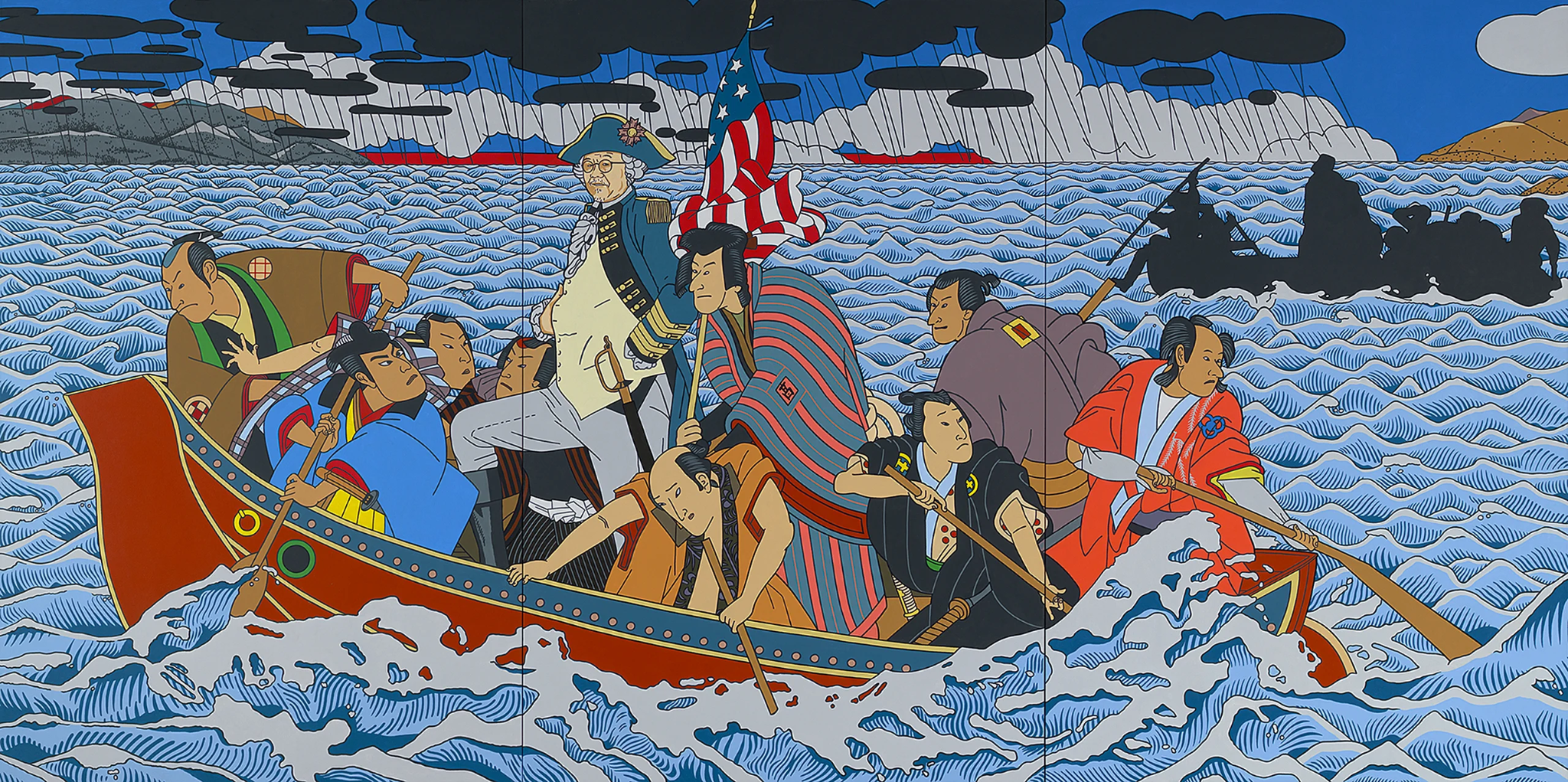
Detail of Roger Shimomura’s Shimomura Crossing the Delaware.
Roger Shimomura, Shimomura Crossing the Delaware
Chapter 1Why a Different Mirror?YPT 4–23
YOUR AIM

What is race?

Course foundations

READ WITH A PURPOSE

Who disappears when American history is told as the story of only one kind of American?

Read the chapter and gather evidence for your explanation.

A racial category changes legal opportunity

Irish immigrants

  1. Irish immigrants are classified as white.

    YPT 12
    qualifies them under the historical rule
  2. The 1790 Naturalization Act permits white immigrants to apply for citizenship.

    YPT 12
    opens a legal route
  3. Irish immigrants can become American citizens despite anti-Catholic prejudice.

    YPT 12

Asian immigrants

  1. Asian immigrants are excluded from the white category.

    YPT 12
    disqualifies them under the same rule
  2. The citizenship rule excludes Asian immigrants.

    YPT 12
    closes that route
  3. Asian immigrants cannot gain citizenship through the route available to Irish immigrants.

    YPT 12

The unequal outcome comes from a racial classification enforced through a historical law.

Book links use YPT page numbers.

01 / Compare

Shared work, unequal belonging

Compare the two sides and their overlap. Select one to emphasize it.

Irish and Chinese experiences in the chapter’s introductory survey · YPT 10–12, 16–18, 22

What this comparison shows

Both Irish and Chinese workers helped build the railroad. The separate sides show how differently they were treated. On the left, Irish immigrants faced hostility because many were Catholic, yet being classified as white allowed them to apply for citizenship. On the right, Chinese immigrants did work employers wanted but were not welcomed as permanent settlers; the 1882 exclusion law restricted Chinese immigration. The overlap shows their shared contribution and shared exploitation: employers taking unfair advantage of workers. Doing similar work did not bring equal rights. The diagram separates two questions: what did people help build, and who was allowed to belong? This helps explain how a country could depend on both groups’ work while giving them very different rights.

YPT 10–12 YPT 16–18 YPT 22
Irish migrants

Irish migration and citizenship

  • Irish immigrants faced hostility in a predominantly Protestant society because they were Catholic.

    YPT 12
  • Classified as white, Irish immigrants could apply for citizenship under the racial rule described in the chapter.

    YPT 12
Shared work

Labor helped build the country

  • Irish and Chinese workers helped build the transcontinental railroad: the Irish worked for the Union Pacific and the Chinese for the Central Pacific.

    YPT 22
  • The chapter connects minority workers through experiences of exploitation, while also showing that competition could divide them.

    YPT 16–18
Chinese migrants

Chinese labor and exclusion

  • Chinese migrants worked as gold prospectors, railroad builders, and later farm and factory workers.

    YPT 10
  • Employers wanted Chinese labor, but Chinese immigrants were not welcomed as permanent settlers; the 1882 exclusion law restricted immigration.

    YPT 10–11

These examples show a shared role in labor alongside different legal barriers. They do not make anti-Irish prejudice and Chinese exclusion identical, or describe every member of either group.

Think it throughWhy does a shared contribution to the railroad not prove that workers received equal membership in the nation?

Work and legal belonging were different questions. Both groups helped build the railroad, but the chapter describes white Irish immigrants as eligible for citizenship while Chinese immigrants faced exclusion. A shared contribution could coexist with unequal rights (YPT 10–12, 22).

02 / Connect

Trace the effects of a historical story

Follow the whole sequence. Open evidence beside a step.

A narrow history can become a narrow idea of who belongs.

The opening taxi encounter leads Takaki to ask how the history people learn affects their recognition of fellow Americans. The chain follows his interpretation of that encounter. YPT 5–7

  1. 01Select one storyEuropean settlement becomes the central story.
    Evidence for this step
    Step 1 / Select one story

    Takaki calls the account that centers European immigrants and pushes other peoples aside the Master Narrative. He gives Oscar Handlin’s immigration history as an example.

    YPT 6–7

    Selection shapes the national picture

  2. 02Define the AmericanWhiteness becomes a test of belonging.
    Evidence for this step
    Step 2 / Define the American

    When the national story identifies Americans as white, people without European ancestry can appear outside the nation even when they were born in the United States.

    YPT 6–7

    The assumption enters everyday encounters

  3. 03Misrecognize a citizenThe driver assumes Takaki is a newcomer.
    Evidence for this step
    Step 3 / Misrecognize a citizen

    Takaki’s driver asks how long he has been in the country and praises his English. Takaki explains that he was born in the United States and interprets the exchange through the Master Narrative.

    YPT 5–6

    The encounter prompts a challenge

  4. 04Recover missing historiesMore voices broaden the historical picture.
    Evidence for this step
    Step 4 / Recover missing histories

    Takaki proposes studying different groups together and listening to people’s stories so that American history reflects people previously treated as invisible.

    YPT 8–9 YPT 18–19

This is the author’s explanation of a particular encounter and his educational response. A story can influence assumptions; it does not determine every listener’s beliefs.

Think it throughHow can a decision about whose past to include affect someone’s present sense of belonging?

A history centered only on white Europeans encourages a narrow national identity. Takaki connects that identity to being mistaken for a foreigner, then proposes a broader history as a way to challenge the assumption (YPT 5–9, 19).

03 / Question

Test the national story

Read a claim. Recall evidence that supports, challenges, or complicates it. Then reveal the evidence.

Chapter claims, evidence, and analysis
Claim or assumptionEvidence that complicates itWhy it Matters
01

The Master Narrative treats Americans as white and primarily of European ancestry.

YPT 6–7
Reveal evidenceHide evidence

“From the beginning, this land was multiracial and multicultural” (YPT 6).

The introduction places Native peoples, European colonizers, and African laborers together in Virginia’s early history; it also recounts Takaki’s birth in the United States.

YPT 5–6

A national identity based on appearance can exclude people whose lives are part of American history.

YPT 5–7
02

The story of America can be told as one shared immigrant experience.

YPT 7–9
Reveal evidenceHide evidence

“These Mexicans did not immigrate into America, however. Instead, the US border was moved” (YPT 13).

Native peoples were already here; Africans were brought in chains; conquest moved the US border over Mexican residents; other people migrated or fled wars.

YPT 13 YPT 15 YPT 20

Comparison must preserve differences among migration, forced transportation, and conquest.

YPT 13 YPT 15 YPT 20
03

Racial and ethnic differences necessarily keep workers divided.

YPT 16–17
Reveal evidenceHide evidence

“Sometimes the workers rose above their racial and ethnic differences, uniting in strikes for better pay or better working conditions” (YPT 18).

The chapter describes both Irish–Black job conflict and joint Mexican–Japanese and Japanese–Filipino strikes.

YPT 16–18

Cooperation was possible, but it required choices across divisions; it was not an automatic result of shared hardship.

YPT 18
04

Ordinary people’s stories are too small to matter to history.

YPT 18
Reveal evidenceHide evidence

“The stories of minorities capture not just moments of history but also powerful emotions and thoughts” (YPT 19).

Takaki uses autobiographical accounts to show suffering, humanity, and family memory that a narrow national account can omit.

YPT 19

Personal testimony can reveal how large historical forces affected people and how they understood themselves.

YPT 18–19

The first row identifies Takaki’s named target. The other rows are review assumptions to test, not quotations or claims that every historian held them. The last column gives interpretations of the cited evidence.

Think it throughWhich evidence most strongly challenges the idea that there is only one route to becoming part of America?

Compare Native presence, forced African transportation, and the changed border over Mexican communities. None fits a simple story of freely choosing to immigrate, although all are central to the nation’s history (YPT 13, 15, 20).

04 / Aim

Evidence and context for your aim

A racial category changes legal opportunity

Irish immigrants

  1. Irish immigrants are classified as white.

    YPT 12
    qualifies them under the historical rule
  2. The 1790 Naturalization Act permits white immigrants to apply for citizenship.

    YPT 12
    opens a legal route
  3. Irish immigrants can become American citizens despite anti-Catholic prejudice.

    YPT 12

Asian immigrants

  1. Asian immigrants are excluded from the white category.

    YPT 12
    disqualifies them under the same rule
  2. The citizenship rule excludes Asian immigrants.

    YPT 12
    closes that route
  3. Asian immigrants cannot gain citizenship through the route available to Irish immigrants.

    YPT 12

The unequal outcome comes from a racial classification enforced through a historical law.

Plan with the 4 Question Method

Connect to the wider course

These document and quarter questions span several chapters.

05 / Connect the course

Three ideas. This chapter.

Move from a detail to a larger pattern. These connections offer interpretations you can test against the reading.

01

Land · Labor · Wealth

Economic forces shape history

Gist

People make choices to get land, money, and the things they need. Those choices can change other people’s lives.

Check your understanding
Check your understanding: A team wants prize money and decides to practice longer. What is the economic goal?

Academic definition

Economic interests shape historical change when people use power to control resources, organize labor, and distribute wealth. Explain the decisions connecting an economic goal to its consequences.

Check your understanding
Check your understanding: Which explanation connects an economic interest to a historical decision?

Elaboration

The introduction links demand for labor to migration and exploitation, while showing that workers could become rivals or allies. Economic contribution did not guarantee equal rights: Chinese workers were wanted for their labor but denied acceptance as settlers. Shared interests could also support organizing across racial and ethnic divisions.

  • Chinese migrants worked in mines, railroads, farms, and factories, yet faced exclusion from immigration during an economic depression.

    YPT 10–11
  • Mexican and Japanese farmworkers struck together in California in 1903; Japanese and Filipino laborers did so in Hawaii in 1920.

    YPT 18
Explore this idea across the book

Try the connectionHow could the same labor system produce both competition and cooperation?

Check your connection

The introduction links demand for labor to migration and exploitation, while showing that workers could become rivals or allies. Economic contribution did not guarantee equal rights: Chinese workers were wanted for their labor but denied acceptance as settlers. Shared interests could also support organizing across racial and ethnic divisions.

Use a detail from the cited reading to explain this relationship in your own words.

02

Categories · Laws · Power

Race is socially constructed

Gist

People made the rules about race. Those rules decide who gets treated as belonging and who gets treated unfairly. People can change the rules.

Check your understanding
Check your understanding: What does “people made the rules about race” mean?

Academic definition

Racial categories and hierarchies are created and enforced through social beliefs, laws, and institutions. Their meanings change across time and place, while their effects on rights and opportunities are real.

Check your understanding
Check your understanding: Which detail shows a racial category being enforced by an institution?

Elaboration

The chapter shows racial categories doing social and legal work: appearance becomes a supposed test of national belonging, and classification as white affects eligibility for citizenship. These examples connect unequal treatment to people’s assumptions and institutional rules rather than to any inherent difference in who can be American.

  • Takaki’s driver treats him as foreign despite his US birth; Takaki connects this assumption to a historical narrative equating Americans with whiteness.

    YPT 5–7
  • The introductory comparison explains that Irish immigrants’ classification as white made them eligible for citizenship under the rule it describes.

    YPT 12
Explore this idea across the book

Try the connectionWhat changes when we ask who set the rule for belonging, instead of accepting that rule as natural?

Check your connection

The chapter shows racial categories doing social and legal work: appearance becomes a supposed test of national belonging, and classification as white affects eligibility for citizenship. These examples connect unequal treatment to people’s assumptions and institutional rules rather than to any inherent difference in who can be American.

Use a detail from the cited reading to explain this relationship in your own words.

03

Justification · Resistance · Change

Ideas are weapons

Gist

A story or belief can help people get others to accept unfair treatment—or work together to change it.

Check your understanding
Check your understanding: A player calls a teammate “useless” to persuade others to exclude them. What is the idea doing?

Academic definition

Ideas influence struggles over power by legitimizing domination, defining belonging, or mobilizing resistance. To explain the connection, identify the idea, who uses it, and the action it helps justify or organize.

Check your understanding
Check your understanding: Which answer explains an idea’s role in power?

Elaboration

Historical stories can make some people seem central and others invisible. Takaki argues that the Master Narrative narrows national belonging, while testimony and comparative history can challenge that boundary. In this interpretation, studying history changes which people readers recognize as participants in the nation’s past and present.

  • Takaki describes a popular historical story that sidelines people who are not of European ancestry.

    YPT 6–7
  • Personal accounts preserve suffering, humanity, and family memory; the different-mirror image calls for a history that reflects everyone.

    YPT 18–19
Explore this idea across the book

Try the connectionHow can adding a person’s testimony change the meaning of a familiar national story?

Check your connection

Historical stories can make some people seem central and others invisible. Takaki argues that the Master Narrative narrows national belonging, while testimony and comparative history can challenge that boundary. In this interpretation, studying history changes which people readers recognize as participants in the nation’s past and present.

Use a detail from the cited reading to explain this relationship in your own words.

06 / 4 Question Method

A taxi ride and American belonging

How to use this organizer

Takaki uses a taxi conversation to question the history that makes some Americans seem foreign.

01Description (Narration)

What happened?

Name the people, actions, and events.

See a model

A taxi driver asked US-born Takaki how long he had been in the country and praised his English.

Takaki was traveling to a teachers’ conference on multicultural education in Virginia.

YPT 5
02Motive (Interpretation)

What were they thinking?

Distinguish what different people wanted and believed.

See a model

Takaki urges readers to recover omitted histories so they can understand how America became a diverse nation.

He proposes comparing groups and listening to people’s own accounts.

YPT 8–9 YPT 18–19
03Cause (Explanation)

Why then and there?

Explain the conditions that made this possible.

See a model

Takaki connects the encounter to a popular historical narrative that identifies Americans with whiteness and European ancestry.

This explains an assumption’s cultural setting; it does not establish the driver’s private intentions.

YPT 6–7
04Ethics (Judgment)

What do we think of that?

Make a judgment and give your reason.

See a model

A defensible judgment is that appearance should not decide belonging: that assumption excludes fellow citizens and obscures their histories.

Consider whose experience a national story recognizes and whose it leaves invisible.

YPT 5–6 YPT 19

Try another example

How would these four questions help explain Mexican and Japanese farmworkers striking together in 1903?

Build an Aim Response

07 / Connect ideas

But/So/Because

but / so / because

  • but

    Takaki was born in the United States, but the taxi driver treated his appearance as evidence that he must have come from another country.

    YPT 5–6
  • so

    Traditional histories left many communities outside the national story, so Takaki proposes studying their experiences together to reveal a more complete picture of America.

    YPT 7–9
  • because

    The Master Narrative can make Americans of Asian ancestry seem foreign because it presents European ancestry and whiteness as central to national belonging.

    YPT 5–7

if / unless / when

  • if

    If we compare Chinese and Irish railroad workers, we can recognize their shared contribution while still examining the different barriers they faced in American society.

    YPT 10–12 YPT 22
  • unless

    We cannot explain the making of multicultural America fully unless we include people who arrived through forced transportation, conquest, migration, and flight from war.

    YPT 13 YPT 15 YPT 20
  • when

    When Mexican and Japanese farmworkers joined a strike in California, their shared demand for better conditions showed that ethnic differences did not prevent cooperation.

    YPT 18

despite / although / however

  • despite

    Despite their contribution to American farms, factories, and railroads, Chinese immigrants faced exclusion, showing that economic usefulness did not guarantee acceptance as permanent settlers.

    YPT 10–11
  • although

    Although Irish Catholics faced hostility in a predominantly Protestant society, their classification as white gave them access to citizenship that Asian immigrants were denied.

    YPT 12
  • however

    Minority workers sometimes competed bitterly for jobs. However, shared exploitation also gave workers reasons to organize across racial and ethnic divisions for better conditions.

    YPT 16–18

08 / Add precise context

Appositives

The bold noun phrase renames the noun beside it, adding historical context inside a complete sentence.

People who challenge the national story

  • Ronald Takaki, the American-born narrator of the chapter, connects a taxi driver’s assumption about his birthplace to the narrow history Americans often learn.

    YPT 5–7
  • Luther Standing Bear, a Sioux speaker quoted by Takaki, challenges the idea that white conquest represented progress by questioning Europeans’ understanding of America.

    YPT 16

Ideas and laws that define belonging

  • The Master Narrative, a national story centered on white European ancestry, can make people whose histories it overlooks seem foreign to the country they helped build.

    YPT 6–7 YPT 22
  • The Chinese Exclusion Act of 1882, a law restricting immigration on the basis of nationality, followed Chinese workers’ contributions to railroads, farms, and factories.

    YPT 10–11

Work and collective action

  • The transcontinental railroad, a transportation link connecting America’s two coasts, depended on Chinese and Irish workers whose labor complicates a national story centered only on Europeans.

    YPT 7 YPT 22
  • The Committee for Industrial Organization, a labor union supporting racial equality in membership, shows how organizing could challenge divisions among workers who experienced similar exploitation.

    YPT 18

09 / See word patterns

Suffixes in Action

Each word appears in this chapter. Its part of speech describes its job in the model sentence. The -ion groups include related -ation forms. Suffixes give useful clues; check how the word is used.

-ment

noun

an action, process, or result

  • settlementnoun

    The settlement at Jamestown brought English colonizers into contact with Native peoples and African laborers, making early Virginia part of a multicultural history.

    settle + -ment → settlement

    Root & originsettle — sit or establish a home Settle is related to Old English setl, a seat, and a verb meaning to seat. Settlement developed senses about establishing a home or reaching an agreement.

    Same-root relativessettle · settler · unsettled

    Word-history source

    Word history: Etymonline

    YPT 5–6
  • movementnoun

    The civil rights movement brought African Americans and allies of other races together to fight for freedoms that changed American society.

    move + -ment → movement

    Root & originmove / mot — move Move and mot trace back to Latin movere, meaning to move, and its related form motus.

    Same-root relativesremoval · motion · motive · motivation

    Word-history source

    Word history: Etymonline

    YPT 9

-ity

noun

a state or quality

  • diversitynoun

    America’s diversity challenges a national history centered only on European immigrants because many Americans trace their ancestry to other parts of the world.

    diverse + -ity → diversity

    Root & originvert / vers — turn Vert and vers come from Latin vertere, meaning to turn, and its related form versus.

    Same-root relativesconvert · conversion · divert · reverse · diverse

    Word-history source

    Word history: Etymonline

    Drop the final e in diverse before adding -ity.

    YPT 7–8
  • equalitynoun

    Workers’ calls for racial equality in union membership challenged divisions that employers and competition for jobs could leave firmly in place.

    equal + -ity → equality

    Root & originequ — equal or level Equ comes from Latin aequus, meaning equal, level, or fair.

    Same-root relativesequal · unequal · equity · equitable

    Word-history source

    Word history: Etymonline

    YPT 16–18

-ful

adjective

having or marked by a quality

  • powerfuladjective

    The Master Narrative is a powerful story because its narrow picture of American identity appears in scholarship, classrooms, and everyday assumptions about belonging.

    power + -ful → powerful

    Root & originpower — be able Power came through French from Latin posse, meaning to be able. English adds parts to the whole base power.

    Same-root relativespower · powerless · empower · empowerment

    Word-history source

    Word history: Etymonline

    YPT 5–7
  • hopefuladjective

    Many immigrants carried hopeful dreams of freedom and opportunity to America, even though prejudice and harsh working conditions could limit what they found.

    hope + -ful → hopeful

    Root & originhope — expectation Hope comes from Old English hopa, meaning hope or expectation.

    Same-root relativeshope · hopeless · hopefully

    Word-history source

    Word history: Etymonline

    YPT 12 YPT 16–18

-ly

adverb

in a particular way

  • painfullyadverb

    Japanese Americans painfully discovered the limits of acceptance when the government confined them in guarded camps during World War II, including many American citizens.

    painful + -ly → painfully

    Root & originpen / pain — punishment or suffering Pain came through French from Latin poena, meaning punishment or penalty. Its meaning expanded to suffering.

    Same-root relativespain · painful · painless · penalty

    Word-history source

    Word history: Etymonline

    YPT 11
  • comparativelyadverb

    Studying Irish and Chinese experiences comparatively reveals both their shared railroad labor and the unequal access to citizenship that separated their legal opportunities.

    comparative + -ly → comparatively

    Root & originpar — equal Compare comes from Latin comparare, to match or pair, built on par, meaning equal. Comparatively describes something in relation to another thing.

    Same-root relativescompare · comparison · comparative · comparable

    Word-history source

    Word history: Etymonline

    YPT 8 YPT 10–12 YPT 22

-er

noun

a person who performs an action

  • drivernoun

    The taxi driver assumed that Takaki had come from another country, illustrating how appearance could become a misleading test of American identity.

    drive + -er → driver

    Root & origindrive — push forward Drive comes from Old English drifan, meaning to drive or push forward. Driver adds -er to name a person who drives.

    Same-root relativesdrive · driving · driven

    Word-history source

    Word history: Etymonline

    Drop the final e in drive before adding -er.

    YPT 5–6
  • workernoun

    A Japanese railroad worker in the chapter’s song takes pride in continuing through difficult weather, adding an individual voice to the history of American industry.

    work + -er → worker

    Root & originwork — effort or activity Work comes from Old English weorc, meaning an action or task. English builds many words from this whole base.

    Same-root relativeswork · working · overwork · workable

    Word-history source

    Word history: Etymonline

    YPT 22–23