How did Russian Jewish immigrants use collective organizing to build power in America, and how did their experience mirror that of Japanese Americans?
Select a highlight to read its note.
No yellow annotations for this aim yet. Blue highlights connect to the key ideas.
Listen to chapter 11
24:57Chapter 11
Jews Are Pushed from Russia
JEWS FROM RUSSIA BEGAN their immigration to the United States in the 1880s. Like many other groups, they were pushed into immigrating by unbearable conditions. But unlike the Chinese and Japanese workers who had at first planned to be temporary workers in America, the Russian Jews came as permanent settlers. They knew there would be no going back.
Persecution in the Old World
Jews were a persecuted minority in Russia. In an important sense, those who fled to the United States were political refugees, because the Russian government itself encouraged acts of violence against the Jews by the Gentiles, or non-Jews.
Repression was everywhere. Jews were confined to a special area called the Pale of Settlement in
western Russia. The law prevented them from owning land, forcing most of them to live in urban areas, towns or villages called shtetls. They earned their livings as merchants and craftspeople. In 1879 almost 40 percent of the Jews worked in manufacturing or crafts. This created economic hardships for them, as an immigrant explained:
It was not easy to live, with such bitter competition as the congestion of the population made inevitable. There were ten times as many stores as there should have been, ten times as many tailors, cobblers, barbers, tinsmiths. A Gentile, if he failed in Polotzk, could go elsewhere, where there was less competition. A Jew could make the circle of the Pale, only to find the same conditions as at home.
Life in the shtetls was intensely insecure. Anti-Semitic violence, or violence aimed at Jews, was a constant reality. Most dreaded were the pogroms, bouts of persecution in which Jews were massacred and their shops and synagogues (temples) destroyed.
“I feel that every cobblestone in Russia is filled
with Jewish blood,” an immigrant bitterly recalled. “Absolutely every year, there was a pogrom before Pesach [Passover]. In big cities during the pogroms, they used any reason to get rid of you. As many Jews as they could kill, they did; but there were some Gentiles who would save you.”
The pogroms made Jews in Russia and Eastern Europe realize that they had to leave. Many of them looked west, to America.
Dreams of the New World
By the time World War I began in 1914, a third ’ of all the Jews in Russia and Eastern Europe had emigrated. Most went to the United States.
In the old country, the air around them had been full of stories about the freedom and better life they could have in the United States. People read letters from America aloud in shops, markets, and synagogues. Children played games, pretending they were emigrating. America stirred people’s hope and dreams of a Promised Land.
Fears of persecution, together with grand visions of a new life, gave the Jews the courage to uproot themselves and leave their birthplace forever. On the streets of the shtetl, women sold their
beds, chairs, kitchen tables, and other belongings to raise money for the passage to America. Taking only their personal possessions, the Jews left the familiar little towns of cobbled streets and crowded marketplaces. Like many other emigrants over the centuries, one man realized only at the moment of departure how long his journey would be. “This was the point at which I was cutting myself off from my past, from those I loved,” he later recalled. “Would I ever see them again?”
When they boarded ships to cross the Atlantic Ocean, the voyagers were herded into crowded compartments below deck, often dark and dirty. Some emigrants traveled on cattle carriers that had been turned into passenger boats. As often as possible the passengers went up on deck to breathe fresh air. They sang Russian folk songs and shared stories.
Finally, after a long crossing, the passengers sighted land. It was a moment of high emotion. “Everybody was on deck,” said Emma Goldman, who was seventeen years old when she arrived from Russia. “[My sister] Helena and I stood pressed to each other, enraptured by the sight of the harbor and the Statue of Liberty suddenly emerging from the mist. Ah, there she was, the symbol of hope, of freedom, of opportunity!”
Who were these newcomers searching for a door to America? In general, they were educated: 80 percent of the men and 63 percent of the women who came between 1908 and 1912 could read and write. Most were poor, but two-thirds of them were skilled workers such as craftspeople. And unlike most other European immigrants, they planned to stay.
Sixty percent of the southern Italian migrants returned to their homeland. For Jews, in comparison, the rate of return was only 3 percent. Another difference was that the Jews immigrated as families. Almost half of them were women, compared to about 20 percent for southern Italians, and a quarter of them were children. They had come to make America their new home.
A Shtetl in America
From the immigration station on Ellis Island in New York Harbor, most of the immigrants headed for New York City’s Lower East Side. During the early nineteenth century German Jews had settled in this neighborhood. As massive waves of Russian Jews began arriving in the 1880s, a new Jewish community blossomed there. By 1905 half
a million Jews lived in the Lower East Side. Unlike nearby Chinatown, with its high population of single men, the Jewish colony had throngs of children.
In this community, Jews seemed to live the same way they had in Russia. They dwelled and worked within a small area, meeting only people
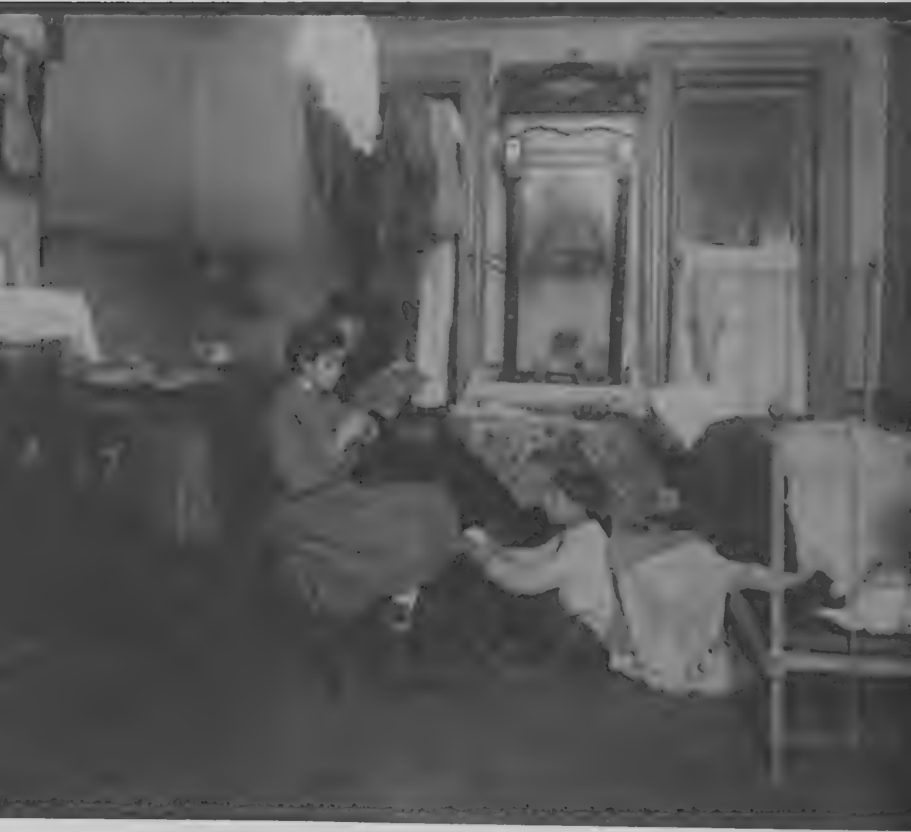
A Lower East Side tenement, New York City, 1912.
like themselves. Yet life moved at a faster pace, with more emphasis on business, bustle, and making money than in the old country. The atmosphere was one of energy and ambition.
The Jewish neighborhood was also a ghetto, crowded, stifling, and often unsanitary. Residents were packed into six- or seven-story tenement buildings. A typical apartment held not just family members but friends and boarders, too. A survey of two hundred and fifty Lower East Side families in 1908 found that half of them slept in rooms with two or three other people, or even more. Many individuals slept on cots or on the floor.
As they settled in the Lower East Side, the Jews established organizations and created a community of services. Landsmanshafts were networks or lodges of people from the same town or district in Russia. Bathhouses, delicatessens, cafés, movie theaters, and synagogues met the immigrants’ needs. In the streets, peddlers sold goods such as buttons, bananas, matches, apples, and clothing from carts. The majority of working Jews, however, were employed in the garment industry.
An Army of Garment Workers
Jewish success in America depended on more than energy. The Jewish immigrants brought useful skills, especially in the sewing trades. Their arrival was timely, because they were needed in New York City’s growing garment industry.
In earlier times, individual pieces of clothing had been tailor-made and measured to fit the buyer, but the Civil War had changed that. To meet the Union Army’s demand for clothing, tailors had established standard sizes and measurements. This let them mass-produce clothing in factories using new inventions such as the sewing machine and the buttonhole machine. The number of garment factories increased rapidly, and the center of this new industry was New York City. By 1910 nearly half the city’s factories and industrial workers were producing clothing.
At first, German Jews had dominated the garment industry. Then the Russian newcomers entered the business, and together they produced good-quality machine-made clothing that could be sold at moderate prices. The Lower East Side became an industrial beehive, block after block of small, busy workplaces called sweatshops, humming with the sound of thousands of sewing machines.
Most sweatshops were small, with fewer than thirty workers, although some were much larger. They were usually run by contractors who rented the space and equipment and who sold the finished garments to larger manufacturers and distributors. Contractors were paid by the piece of finished clothing, so there was pressure to make as many pieces in as little time as possible.
Laborers worked in teams, with members given specific tasks such as cutting cloth, operating sewing machines, making buttonholes, or pressing the garments. The team received a group wage based on the number of garments they produced, with each member getting a percentage based on his or her task. This system drove everyone to work hard, because each member wanted to speed up the team’s pace of production. Performing the same tasks over and over, skilled tailors and seamstresses felt like slaves.
Sweatshop work was physically punishing: hot, noisy, and dangerous. Accidents such as stitching fingers with sewing machines were common. The workday was long, from eleven to fifteen hours. “My work was sewing on buttons,” one sweatshop employee said. “While the morning was still dark I walked into a dark basement. And darkness met me when I turned out of the basement.”
Daughters of the Colony
Thousands of the garment workers were young women. Many had come to the United States on their own, before their families, because they possessed sewing skills. They could get work, save money, and help the other family members.
These young Jewish women made up more than a third of the garment industry’s workforce in 1910. In the sweatshops they were packed together elbow to elbow, operating sewing machines at rows of long tables, so crowded that there was no way to escape in case of emergency.
Disaster struck on March 25, 1911, when a fire suddenly broke out at the Triangle Shirtwaist Company. Eight hundred workers, mostly young women, were trapped in the burning building. Screaming, struggling, they jumped from windows, some from the ninth floor, their bodies smashing onto the sidewalks. Jumping from the higher floors, the girls came down with such force that they tore the nets from the firemen’s hands. A hundred and forty-six workers, mostly Jewish and Italian, died. There were so many dead and injured that they could not all be taken away in ambulances and patrol wagons. Grocers and peddlers offered their carts.
Mothers rushed to the scene, where they saw their daughters’ blackened bodies laid out on sidewalks. News of the horror rapidly spread to the shtetls of Russia, causing a panic. Families feared that their own daughters or granddaughters or cousins were among the dead.
One reporter wrote, “I looked upon the dead bodies and I remembered these girls were shirtwaist [blouse] makers. I remembered their great strike of last year in which the same girls had demanded more sanitary conditions and more safety precautions in the shops. Their dead bodies were the answer.”
The Great Strike The “great strike” that the reporter mentioned had taken place in 1909-1910, when workers at three factories—including the Triangle Shirtwaist Company—had walked away from their machines and demanded better working conditions. They asked the International Ladies’ Garment Workers’ Union (ILGWU) to call for a general strike in the entire shirtwaist industry. But the ILGWU had just been founded, and it lacked the resources to organize such a massive strike. The power to do so had to come from the people themselves.
The women strikers organized a mass meeting at Cooper Union, a private college on the Lower East Side. Thousands of people came to show support for the strikers and to criticize the factory bosses—and also the police who were arresting strikers and the hired thugs who were beating them. Inspired by the meeting, the next morning fifteen thousand more shirtwaist workers went on strike. The strike eventually involved twenty thousand workers, overwhelmingly Jewish. Their demands included a fifty-two-hour workweek, overtime pay, and recognition of their union.
During the strike, the Lower East Side was a seething mass of excited demonstrators. Whole neighborhoods burst into applause when word came that another boss had settled with the strikers. By February 1910, more than 300 of the 450 or so shirtwaist businesses in New York had been forced to make some kind of settlement. One was the Triangle Shirtwaist Company. Tragically, although the company agreed to most of the strikers’ demands, it did not make safety improvements in time to save the lives of those who perished in the fire a year later.
The Jewish community was proud of its brave and determined strikers, who were com-
memorated in a poem called “The Uprising of the Twenty-Thousand”:
In the black of the winter of nineteen nine,
When we froze and bled on the picket line,
We showed the world that women could fight
And we rose and we won with women’s might.
Chorus:
Hail the waistmakers of nineteen nine,
Making their stand on the picket line,
Breaking the power of those who reign,
Pointing the way, smashing the chain.
Several months later another strike erupted when fifty thousand cloak and suit workers walked off their jobs. This strike ended with a compromise between strikers and bosses, in which the strikers received some of the benefits they had demanded.
These labor struggles were a landmark in Jewish American history. They launched a decade of strikes in the garment trades and a period of union growth. “By the end of World War I [1918],” writes labor historian Susan A. Glenn, “clothing workers were among the best-organized members of the American labor force.”
The garment strikes were a movement for workers’ rights, but they were also an ethnic movement. The great majority of strikers were Jewish, and their struggle held the attention of the Jewish community in America. The labor triumphs sharpened a shared sense of ethnic identity, and in turn Jewish Americans took a continuing interest in the labor movement.
From “Greenhorns” to Americans
When Jewish immigrants arrived in the United States, they were foreigners in their dress, language, and thinking. They called themselves “sreenhorns,” newcomers who did not yet know their way around. Eager to assimilate into American society, the greenhorns wanted to become modern, to blend in.
To blend in, however, they had to give up certain customs. They had to abandon the clothes they had worn in the shtetls, for example, and dress in the American style: hats instead of caps, collars and neckties for men, bright-colored shirtwaists and jackets for women instead of brown dresses and shawls.
Language was also a mark of assimilation. In
Russia the Jews had spoken their own language, Yiddish. Few of them made any effort to learn the dominant language, Russian. As immigrants in America, though, they were eager to learn English. In a letter to a Jewish newspaper in New York, a mother complained about her daughter: “During the few years she was here without us she became a regular Yankee and forgot how to talk Yiddish. ... She says it is not nice to talk Yiddish and I am a greenhorn.”
The quest to become American led some Jewish immigrants, perhaps many of them, to change their names. Bochlowitz became Buckley, Stepinsky became Stevens. First names changed, too. Rivka became Ruth, Moishe became Morris.
As successful Jews adopted American habits, they celebrated American holidays. To some, exchanging presents at Christmas—which is not a Jewish holiday—was one of the first signs that one was not a greenhorn. Jewish people also began taking vacations, favoring resorts in the Catskill Mountains of New York State. Married women withdrew from the workforce. To have the luxury of not working meant that the wives and their families were economically and socially successful.
Ambition and Education
As unionized workers and businesspeople, the Jewish immigrants acquired the means to educate their children. They were driven by a determination to have the second generation be professionals rather than laborers or merchants.
This determination, however, benefited mostly the sons of the immigrants. Many daughters worked in the sweatshops, contributing their earnings to the family to help pay for their brothers’ schooling. In 1910 the income of working daughters amounted to nearly 40 percent of the average Jewish family’s earnings.
Meanwhile, young Jewish men were going to the colleges and universities of New York City and other places along the East Coast. By 1916 nearly half the students at New York’s Hunter College and almost three-quarters of those at City College were Jewish. Around that time Jews also began to enter Harvard in Massachusetts, which many considered to be the most elite and prestigious college in the country. A fifth of Harvard’s student population was Jewish by 1920.
But the increasing presence of Jewish students at Harvard led to a backlash. In 1923 a magazine writer complained that ambitious and upwardly
mobile Jewish immigrants sent their children to college a generation or two earlier than other immigrant groups, which meant that there were “more dirty Jews and tactless Jews in college than dirty and tactless Italians, Armenians, or Slovaks.” Anti-Semitic grumbles swept across the campus. Some students resented the Jewish students because their grades were so high that they made other students look bad.
Abbott Lowell, president of Harvard, announced that the college had a “Jewish problem.” He led efforts to reduce Jewish enrollments. One of his arguments was that keeping the number of Jewish students to a minimum would prevent anti-Semitic feeling on campus.
New admission guidelines at Harvard placed emphasis on “well-rounded” applicants rather than simply on grades, and called for more students from areas other than New York City. Applicants were also required to submit photographs because many people believed it was possible to identify Jews, even if they had changed their names, by their facial features.
Not everyone agreed with Lowell’s views. Mayor James Curley of Boston, an Irish American, spoke out against discrimination aimed at Jews. “All of
us under the Constitution are guaranteed equality, without regard to race, creed, or color,” Curley declared. “If the Jew is barred today, the Italian will be tomorrow, then the Spaniard and the Pole, and at some future date the Irish.”
A New Nativism
The anti-Jewish restrictions at Harvard were part of a larger movement of nativism, a way of thinking that favored the established inhabitants of a region or country over newcomers and immigrants, and that placed “native-born” people’s interests ahead of the interests of others.
This surge of nativism led to a strict new Immigration Law of 1924 that Congress passed. The law was designed to reduce immigration from southern and eastern Europe. It established quotas, or limits, on the number of people who could enter the United States from each nationality. Each quota was equal to 2 percent of the total number of people of that nationality who had been in the United States in 1890. In other words, the quota system adopted in 1924 was based on population figures that were already more than thirty years old.
Because large-scale Jewish immigration did not occur until after 1890, the number of Jews in America in 1890 was not great—and the number now permitted to enter the country each year was just 2 percent of that number. The same held true for other nationalities. The Chinese Exclusion Act of 1882 had introduced the idea of limiting immigration by nationality. The law of 1924 applied that principle to many immigrant groups, not just one.
The German Jews who had arrived earlier had been welcomed in US society. What made the more recent wave of Russian and Eastern European Jews seem threatening to Americans? They were culturally more different from Americans of English, Scottish, and Irish descent than the German Jews had been. They arrived in much bigger numbers, making people fear an “invasion” of ambitious foreigners who seemed highly successful. In addition, the Russian Jews’ involvement in the labor struggle and their participation in strikes seemed threatening.
The more the Jews succeeded, the better they assimilated, the more American nativists disliked them. Hostility sharpened as the Jews began moving out of the Lower East Side, closing the distance between themselves and Gentile America. When
Jews tried to buy homes in more middle-class neighborhoods, they often encountered rules that specified that property could not be sold to Jews. Still, during the 1920s more than a hundred thousand Jews left the Lower East Side, spreading into more distant parts of New York City, such as Brooklyn and the Bronx, and beyond.
Years earlier, as refugees, Jews had fled the shtetls of Russia to what they saw as the Promised Land of America. Now they, or their children, were migrating again, embracing the possibilities of life in the United States, striving to assimilate and become Americans.
CLARA LEMLICH WAS A CHILD WHEN SHE developed a secret reading habit. She was a teenager when she came to America, and she was only twenty-three years old when she helped lead the great garment workers’ strike of 1909-1910.
Lemlich was born in 1886 in Ukraine, which was then part of Russia. Her parents would have sent her to school, but the Russian school did not admit Jews. They forbade her to speak or read Russian, but Clara defied her father’s orders, learned to read, and borrowed books whenever she could. She secretly wrote letters for neighbors to pay for her book habit. One neighbor's revolutionary pamphlets convinced her of the need for political and social change.
When Lemlich was seventeen her family emigrated to America to avoid the pogroms. She found work in a garment shop on the Lower East Side. Appalled by conditions in the workplace, she got involved in organizing a union. When the first shirtwaist workers’ strikes broke out in 1909, Lemlich was warned by older male union members—who
considered her a hot-headed pest—that young women could not carry out a large, long-term general strike. She ignored them.
During the historic mass meeting at the Cooper Union, while workers and their families shared their grievances, Lemlich rushed to the platform and insisted on speaking. “I am a working girl,” she cried out, “one of those striking against intolerable conditions.” Then she said, “I am tired of listening to speakers who talk in generalities. What we are here for is to decide whether or not to strike. I offer a resolution that a general strike be declared— now!” The chairman of the meeting jumped to the platform and joined hands with Lemlich. The two raised their hands high, the crowd pledged to strike, and the next morning twenty thousand workers walked off their jobs.
After the strike Lemlich could not get hired at any New York garment shop. Throughout the rest of her life, in addition to becoming a wife and mother, she fought for women’s suffrage, socialism, and the rights of consumers and tenants, and later against nuclear weapons. She died at ninetysix in a Los Angeles nursing home, where she had helped the orderlies organize a labor union of their own.